How To: What Ply Or Load Range Do I Need For My Trailer?

Load Range Is More Important Than You Think.
Choosing the right radial tire ply rating (more accurately called load range) for towing is one of the most practical safety decisions a trailer or truck owner makes. A tire that looks fine on the rack can still overheat, flex excessively, or fail if its capacity does not match the weight it must carry. The goal is straightforward: know the actual load, match or exceed the tire’s published capacity with a margin, and buy tires built for the job.
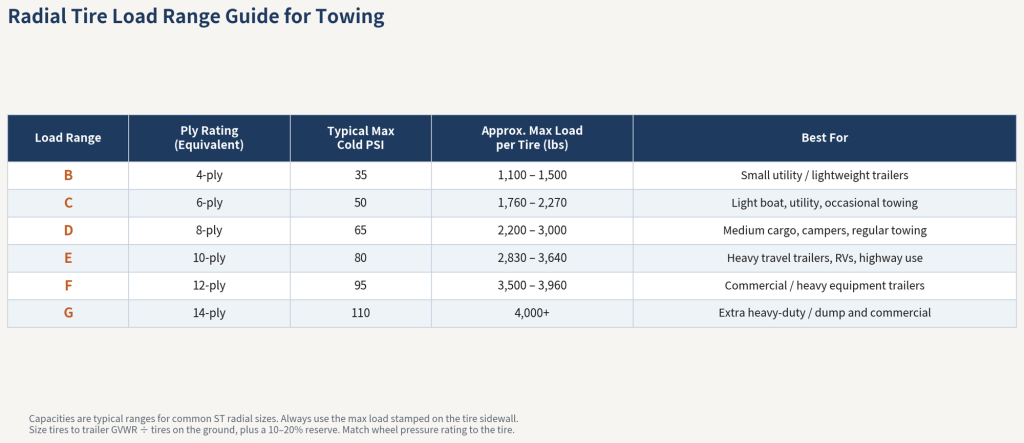
Modern “ply” ratings are strength equivalents, not literal layers of fabric. Stronger materials mean fewer physical plies can deliver higher capacity. The common load-range letters used on light-truck and trailer radials line up roughly like this: Load Range C equals a 6-ply rating and is typically inflated to about 50 psi; Load Range D equals 8-ply and runs near 65 psi; Load Range E equals 10-ply and is rated around 80 psi; Load Range F equals 12-ply near 95 psi. Exact maximum load in pounds is stamped on the sidewall and varies by size and brand, so the letter is only a starting point.
For the trailer itself, start with the gross vehicle weight rating (GVWR) on the certification label, not the empty weight. Divide that figure by the number of tires actually on the ground (two for a single axle, four for a tandem). A 3,500-pound single-axle trailer needs each tire to support at least 1,750 pounds before any reserve. A 7,000-pound tandem needs the same 1,750 pounds per tire; a 10,000-pound tandem needs 2,500 pounds per tire. Industry practice and tire specialists commonly recommend adding a 10–20 percent cushion for uneven loading, heat, age, and road shock. That pushes the 1,750-pound example toward roughly 2,000 pounds of capacity and the 2,500-pound example toward about 2,875–3,000 pounds.
Those numbers map cleanly onto common Special Trailer (ST) radial sizes. Load Range C tires (often ST205/75R14 or ST205/75R15) commonly carry roughly 1,700–1,900 pounds and suit lighter utility or boat trailers. Load Range D tires in similar or slightly larger sizes often reach 2,150–2,540 pounds and cover many medium cargo and travel trailers. Load Range E tires, such as ST225/75R15 or ST235/80R16, frequently support 2,800–3,600 pounds and are the usual choice for heavier travel trailers, equipment haulers, and frequent highway use. Stepping up one load range when the math lands close to a tire’s ceiling is generally safer than running at the absolute limit, provided the wheels are rated for the higher pressure.
ST-Rated or LT-Rated?
Trailer tires should be ST-rated radials unless the manufacturer specifically calls for something else. ST construction uses stiffer sidewalls to resist the lateral forces and sway that appear when a load is towed rather than driven. A light-truck (LT) tire of the same size and load-range letter is not automatically interchangeable; actual pound capacity and sidewall behavior can differ. Passenger tires are unsuitable. Radial construction is preferred for highway miles because it runs cooler and wears more evenly than bias-ply; bias-ply tires remain an option mainly for low-speed, local work. Never mix radial and bias tires on the same trailer.
The tow vehicle needs its own calculation. Tongue weight (commonly 10–15 percent of trailer weight for conventional hitches, higher for some fifth-wheels) lands on the rear axle along with passengers and cargo. The combined load capacity of the vehicle’s tires, at the pressures listed on the door placard, must cover the loaded vehicle weight plus that tongue weight. Many half-ton trucks manage moderate towing on Load Range C or D tires when those match the placard. Three-quarter-ton and one-ton trucks, and any vehicle regularly towing near its rating, commonly need Load Range E (10-ply equivalent) LT tires. Higher load ranges add sidewall stiffness that improves stability under tongue weight, but they do not increase the vehicle’s official tow rating. Always meet or exceed the original equipment load index and load range; installing a higher-rated tire is acceptable only if the wheels can handle the required pressure.
When buying, read the full sidewall marking. Confirm the size (width, aspect ratio, construction, and rim diameter), the load range letter, the load index number (which converts to an exact pound rating), and the speed rating. Trailer tires are often limited to L (75 mph) or M (81 mph); exceeding that rating builds heat quickly. Check the DOT date code—the four-digit week-and-year stamp. Tires older than about six years, even with deep tread, can have degraded rubber and are a poor choice for towing. Buy from a seller who can confirm the tires are current stock.
Match the wheel. A Load Range E tire that needs 80 psi is useless on a rim rated only to 50 psi. Keep bolt pattern, offset, and diameter compatible. Look for a reputable brand with a clear warranty and, if possible, road-hazard coverage; trailer tires see more heat and standing time than drive tires. Inspect for even tread, intact sidewalls, and proper valve stems. After mounting, set cold pressures to the trailer placard or the tire’s maximum (whichever the application requires) and recheck them before every trip—under-inflation is the leading cause of trailer tire failure.
Finally, weigh the loaded rig at least once. Scale tickets reveal whether the real distribution matches the paper calculation and whether one side or axle is overloaded. Combined with the correct load-range radial, fresh date codes, and disciplined pressure checks, that simple step keeps both the trailer and the tow vehicle inside the margins the tires were designed to provide.