


Repair or Replace Your Utility Trailer?

Repair or Replace Your Utility Trailer? How to Make the Call Before You Waste Money—or Risk a Breakdown
A utility trailer rarely fails all at once. It fades. A tail light starts blinking only when it rains. A deck board softens under a mower wheel. A weld at the ramp hinge hairlines. Then a hub runs hot on the highway and you are standing on the shoulder wondering whether the next check should go to a welder or a dealer.
That is the real decision. Not “Is this trailer old?” Every trailer gets old. The useful question is whether the next dollar buys more safe, predictable years—or whether it only delays a replacement you already need. A well-built tandem-axle trailer used a few times a month can stay useful for 15 to 20 years. A cheap single-axle unit that lives outside, gets overloaded, and never sees a bearing pack may be finished in five. The right call comes from structure, safety, remaining life, and math—not sentiment and not the first shop quote that sounds cheap.
This guide walks through the numbers, the inspection points, and the situations where repair is the smart move versus the situations where buying new (or a better used trailer) is the cheaper, safer path.
Start With Value and Remaining Life, Not the Repair Invoice
Before you price a weld or an axle, establish two figures: what the trailer is worth today and how many reliable years it still has after the work.
In 2026, a new small single-axle utility trailer commonly sells for $1,500 to $3,000. A larger tandem-axle model typically lands between about $3,700 and $8,000 depending on length, GVWR, brakes, ramp style, and whether the frame is steel or aluminum. Used utility trailers often trade between $1,000 and $3,500, with a market median near $2,000. Your current trailer is almost never worth what you paid and almost never worth a comparable new unit. That gap is the backdrop for every repair decision.
Lifespan is just as uneven. A steel utility trailer stored under cover, kept within its rating, and maintained can last 10 to 18 years. Aluminum trailers often reach 20 years or more because they do not rust the same way. Road salt, standing water on the deck, fertilizer and wet soil packed against steel, skipped bearing service, and regular overloading all cut that window short. Quality of the original build matters too. A heavy frame from a reputable maker and a thin big-box trailer do not age on the same calendar.
Write down a rough private-party value. Then answer a harder question: after this repair, how many years of the same duty cycle do you honestly expect? Two more seasons of light weekend use is a different investment than a decade of weekly job-site hauling.
Financial Tests That Keep You Honest
Two thresholds show up again and again among shops and fleet managers because they prevent slow-motion overspending.
The first is the single-job test. If parts and labor for the work in front of you exceed about 50 percent of the trailer’s current market value, replacement usually wins. A $1,800 axle-and-deck job on a trailer worth $2,200 does not leave you with a $4,000 trailer. It leaves you with an old frame, old wiring, old springs, and a large receipt.
The second is the annual-spend test. If yearly repairs consistently run above 30 percent of current value, you are financing a replacement one invoice at a time. Downtime belongs in that math. For a contractor, eight to ten unplanned days in the shop in a year often costs more than the parts. A homeowner feels that pain as cancelled dump runs and rented trailers. A business feels it as missed revenue.
These rules are starting points. A $400 wiring repair on a structurally sound $2,500 trailer is almost always worth doing. The same $400 on a trailer that also needs a bent axle, a rotten deck, and a cracked tongue is a delay. Always price the cluster of problems, not the one that happened to fail this week.
Add a buffer for the next likely failure. If the hubs are due, the tires are six years old, and the deck is already staining dark at the edges, a “small” brake job is not small. It is the first line item on a longer list.
Inspect the Systems That Carry Load, Not the Paint
Faded paint and surface rust look bad. They rarely decide the outcome. The systems that should drive the choice are the ones that keep the load on the road and attached to your hitch.
Frame, tongue, and welds
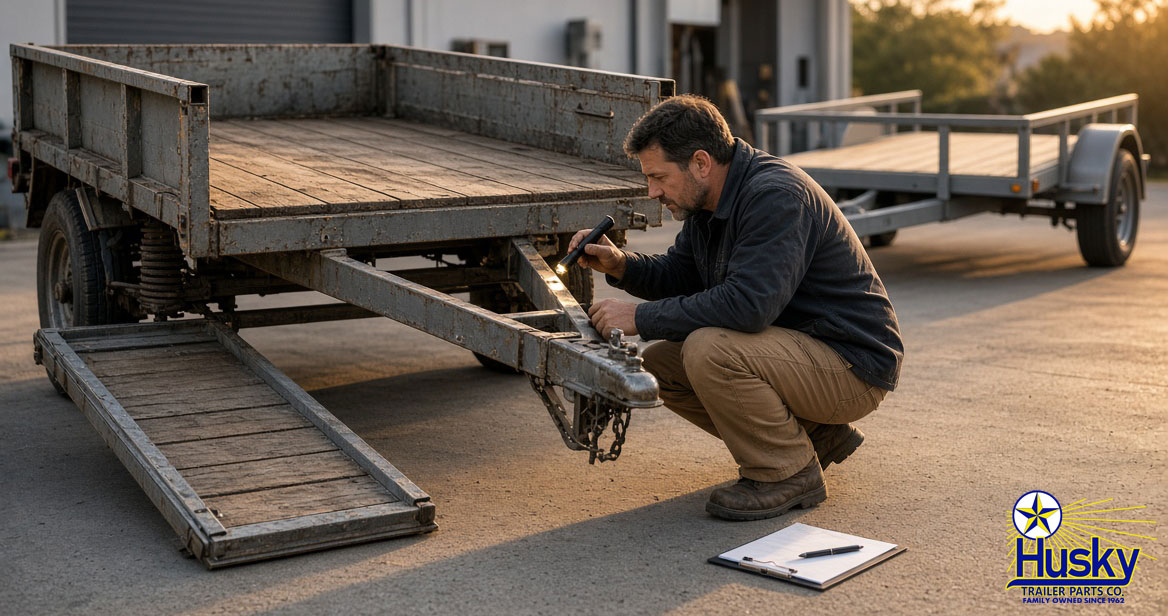
Get under the trailer with a flashlight. Check the tongue where it meets the frame, the coupler mounting area, spring hangers, crossmembers near the axle, and any old weld patches. Press on suspect metal. Flaking scale that comes off in sheets, holes, or metal that flexes under hand pressure is structural, not cosmetic. A single localized crack in a ramp hinge or a bracket, with solid surrounding steel you can grind to clean metal, is often a straightforward weld. Multiple cracks, a bent main rail, a twisted tongue, or thin pitted metal around the joint means the structure is tired. Previous patches in the same corner are a warning. Welding cannot restore original strength if the base metal is already gone.
Axles and suspension
Early bearing trouble—a hum, a little play, a hub that runs warmer than the other side—is often an $80 to $200 pack-and-seal job per axle if you catch it. A bent axle tube, a scored or blued spindle, cracked tube welds, or a torsion axle that has lost geometry is a replacement item. Installed replacement commonly runs $400 to $1,700 for a typical utility axle and can reach $1,500 to $3,500 for torsion or heavier assemblies. Straightening a bent tube leaves work-hardened, weaker metal. Repeat bearing failures after a fresh pack often mean the spindle is already damaged. Uneven tire wear that returns after alignment checks is another axle or hanger problem in disguise.
Deck and crossmembers
Wood decks rot from the underside first. Road splash, trapped leaves, and wet loads sit against the boards where you cannot see them. By the time the top feels spongy, the underside may have been failing for a year. Swapping a few boards early might cost $120 to $200. Waiting until the whole deck is compromised can push a job past $400, and a full redeck often lands between a few hundred and well over $1,000 depending on size and material. A rotten deck on sound crossmembers is a repair. A rotten deck on rusted, scalloped crossmembers is a frame conversation. Steel floors have their own version of the same problem: rust-through at weld seams and low spots that hold water.
Brakes, lighting, and wiring
Brake service typically runs $150 to $450 per axle. A connector or a pair of lights is inexpensive. A full rewire can run $300 to $600. Persistent electrical ghosts on a 12- to 15-year-old harness—lights that work on the bench and die on the road—usually mean cooked insulation and failing grounds in several places. Chasing one circuit at a time on a trailer that needs everything else is false economy. If the trailer is heavy enough to require brakes in your state and those brakes are weak, that is not optional maintenance. It is a legal and safety item.
Tires, coupler, jack, ramps, and tie-downs
Trailer tires often age out before they wear out. Many shops treat five to seven years as a replacement interval even with tread left. Check the DOT date code. A coupler that rocks on the ball, a latch that takes a hammer, or a jack that leans is usually cheap to correct if the frame under it is sound. Ramp hinges and D-rings that have pulled at the weld tell you about both hardware and the metal they are attached to.
Photograph problem areas. Note whether failures are isolated or repeating. Get at least one written estimate that separates “must-fix for safety” from “nice while it is here.” That must-fix number is what you compare with a replacement.
When Repair Is the Smart Move
Repair makes sense when the problem is contained and the trailer still matches how you actually use it.
Repair if:
- The frame rails, tongue, and axle mounts are straight and the metal still has thickness.
- The issue is limited to consumables: bearings, brakes, tires, lights, a coupler, a jack, or a handful of deck boards.
- This is the first failure in that area, not the third weld in the same corner.
- You reasonably expect five or more years of the same duty cycle after the work.
- The quote sits well below half the trailer’s value and well below the price of a new unit that actually fits your needs.
- You already like the size, ramp style, and capacity.
A homeowner with a 6×12 that needs new tires, a bearing service, and two deck boards is almost always better off repairing. A landscaper whose only problem is a broken ramp hinge on an otherwise tight frame is in the same position. Catching floor rot and bearing wear early is how trailers reach the long end of their lifespan instead of the short end. About three-quarters of routine trailer issues can be handled with maintenance or modest repairs if they are not ignored.
DIY is reasonable for boards, lights, and some hardware if you are competent and honest about torque, wiring, and wood that is truly sound. Axles, brakes, structural welding, and anything that affects tracking or the connection to the tow vehicle belong in a shop. A bad spindle weld is not a savings. It is a highway risk.
A worked example helps. Suppose a 10-year-old 6×12 is worth about $1,800 used. Tires are $400 for the set. Bearings and seals are $180. Two boards and some hardware are $220. Total is about $800. That is under half the trailer’s value, leaves the frame untouched, and can easily buy several more years. Repair.
Change one fact. The same trailer also has a bent axle and soft crossmembers. Now the quote is $800 plus $1,400 for the axle plus deck and steel work. You are over the value of the trailer and you still own tired steel. Replace.
When Replacement Is the Better Decision
Replacement wins when you would be buying time, not capability.
Replace if:
- Corrosion has reached the frame, axle mounts, or hitch connection in a way that welding cannot confidently restore.
- The main frame or tongue is bent, or cracks keep appearing in load-bearing members.
- You would need a new axle and a new deck and a rewire on a trailer that is already 12 to 15-plus years old.
- Capacity no longer matches the work—you load close to GVWR, you now need brakes, or you need a longer bed and a better gate than the old trailer will ever have.
- The repair history is a stack of temporary fixes.
- Downtime is becoming a pattern, especially if the trailer earns money.
- A good shop’s honest recommendation is that the next failure is already visible.
A trailer can look fine from ten feet and still be a poor candidate for more money. Flaking scale, holes in the frame, a coupler that rocks, and a deck that flexes underfoot are the structure talking. Patches can buy months. They do not reset fatigue in a rail that has already cracked twice.
Replacement is also the right call when your needs have changed. Spending $2,000 to resurrect a 5×8 you have outgrown is worse than putting that money toward a 7×14 with brakes. A new trailer brings a warranty, current lighting, better ramps, and a known axle rating. For many owners those extras matter more than one more season from a tired frame.
Used replacements can close the cost gap. A sound used trailer with a good frame and fresh running gear often beats both a tired repair project and a brand-new unit—if you inspect it the same way you would inspect your own: frame first, then axles, then deck and wiring. Walk away from a cheap used trailer with a pretty deck over a rusty tongue. That is how people buy someone else’s problem.
Business Use, Personal Use, Climate, and Upgrades
Personal and commercial math diverge. A weekend trailer under a carport can justify a sentimental repair. You are not losing billable days. A contractor or landscaper should treat the trailer as equipment. Missed jobs, extra tire wear from a bent hanger, and the liability of a failure on the highway all belong in the spreadsheet. If the trailer is constantly the wrong size for the crew’s current machines, replacement is an operations decision, not just a maintenance one.
Ask whether repair locks you into yesterday’s spec. Adding electric brakes, a fold-over ramp, or a higher GVWR to an old frame is sometimes possible and often more expensive than expected. If you already know you want those features, put the repair money toward the trailer that has them from the factory.
Climate changes the clock. Steel in a salt-belt state or on the coast needs more rust prevention than the same trailer in a dry climate. Aluminum costs more up front and usually costs less in rust-related repairs later. That difference should influence a replace decision if you plan to keep the next trailer a long time. Storage matters as much as mileage. A covered trailer with a dry deck ages slower than an identical unit parked in grass with a tarp that traps moisture.
Timing can save money. Late fall and midwinter are often better moments to shop new or used inventory than the first warm Saturday of spring, when everyone else wants a trailer the same weekend their old one fails.
If you replace, do not leave value on the table. A trailer that is unsafe to tow can still have usable tires, a winch, a good jack, or scrap steel. A trailer that is tired but not dangerous can sell to someone with lighter needs if you disclose the issues. Honesty is cheaper than a dispute.
A Decision Sequence You Can Run in One Afternoon
Use this order so emotion does not jump the line.
- Park the trailer and inspect frame, tongue, axle mounts, deck underside, hubs, and coupler. Note isolated versus widespread damage.
- Get a written estimate that itemizes safety-critical work versus optional work.
- Price a comparable new trailer and a clean used one of the size you need now, not the size you needed when you bought the old one.
- Apply the 50 percent test to the must-fix items and add a buffer for the next visible weak point.
- Factor remaining life and downtime. Five good years after a $600 repair is a win. Eighteen months after a $2,000 structural patch is not.
If safety is uncertain, do not split the difference. A trailer that cannot be confidently restored should be retired. If several signals point the same way—high repair-to-value ratio, structural doubt, mismatched capacity, repeating failures—you already have the answer.
The Bottom Line
Repair when the bones are good and the bill is a maintenance event. Replace when the bones are tired, the failures are multiplying, or the trailer no longer fits the work. The 50 percent rule, a hard look at the frame and axles, and an honest estimate of remaining years will get you there faster than staring at rust and guessing.
A utility trailer is inexpensive compared with the damage it can cause if a wheel comes off or a tongue fails. Spend the money where it buys reliability. Sometimes that is a bearing pack and new boards. Sometimes it is a new trailer and a clean title. Either choice is reasonable when you make it on purpose instead of after the next breakdown.

Get the Parts You Need From Husky Trailer Parts Co.
Complying with DOT lighting regulations protects you from fines and keeps everyone on the road safer. At Husky Trailer Parts Co., we’ve spent over 60 years helping trailer owners find the right parts to keep their trailers compliant. As a family-owned business, we also understand the importance of getting it right the first time.
Our extensive inventory includes everything from tail lamps and reflectors to LED upgrades and wiring connectors. Whatever you need, all of our products are built to meet federal standards. So, whether you’re replacing a single bulb or outfitting a brand-new trailer, we’re here to help you stay legal and visible.
Find DOT-compliant trailer lights and get your trailer up to standard today.
